5 Hard-Learned Lessons From My First Year as a GA in Strength & Conditioning
Your GA years aren’t about proving how much you know — they’re about learning how to coach, communicate, and adapt.
In August 2021, I finally got my opportunity to serve as a Graduate Assistant Strength
and Conditioning Coach for Temple University’s Olympic Sports Strength and Conditioning
staff. This was an excellent opportunity for me to not only serve the department but also develop
my skillset to become the best coach possible for the future. Below are 5 of the biggest lessons I
learned and items I believe every new GA should consider.
#1 KISS: Why Simple Programs Win
When I first arrived at Temple University, I was excited to finally apply what I’ve learned
from my internship experiences at Reach Your Potential Training (RYPT), MSU Denver, and
University of Minnesota’s Hockey program with Cal Dietz. When I was tasked to write my first
program at Temple University as a Graduate Assistant, the members of the staff at the time (Tim
Teefy, Ben Steenrod, Tyler Kishbaugh, Pete Franco and Abi Goldberg) emphasized keeping my
programs simple. However, I wanted to prove my knowledge and the first programs I built were
too complex and I was trying to recreate the new triphasic training elements I learned from Cal
Dietz and fit it into the new place I arrived in.
The best advice I found was when I read The Gamut of Performance by Juan Carlos Perez; Jamie Pasquin contributed to a crucial chapter that I still refer to this day. The chapter discussed understanding your constraints. How much space do you have? What equipment is available? What are your athletes capable of performing/where are they at with their development? And more importantly, will the program flow well with the room? If you have zero flow and
the athletes don’t understand the program, then nobody will get better.
With my case at Temple with Cheer and Dance, I had around 20-40 athletes at a time in the room with maybe 2 other intern coaches to assist. Additionally, the Cheer and Dance athletes’ training age was relatively young. With these factors in mind, writing a complex program such as the French Contrast with Performance Pattern Cycling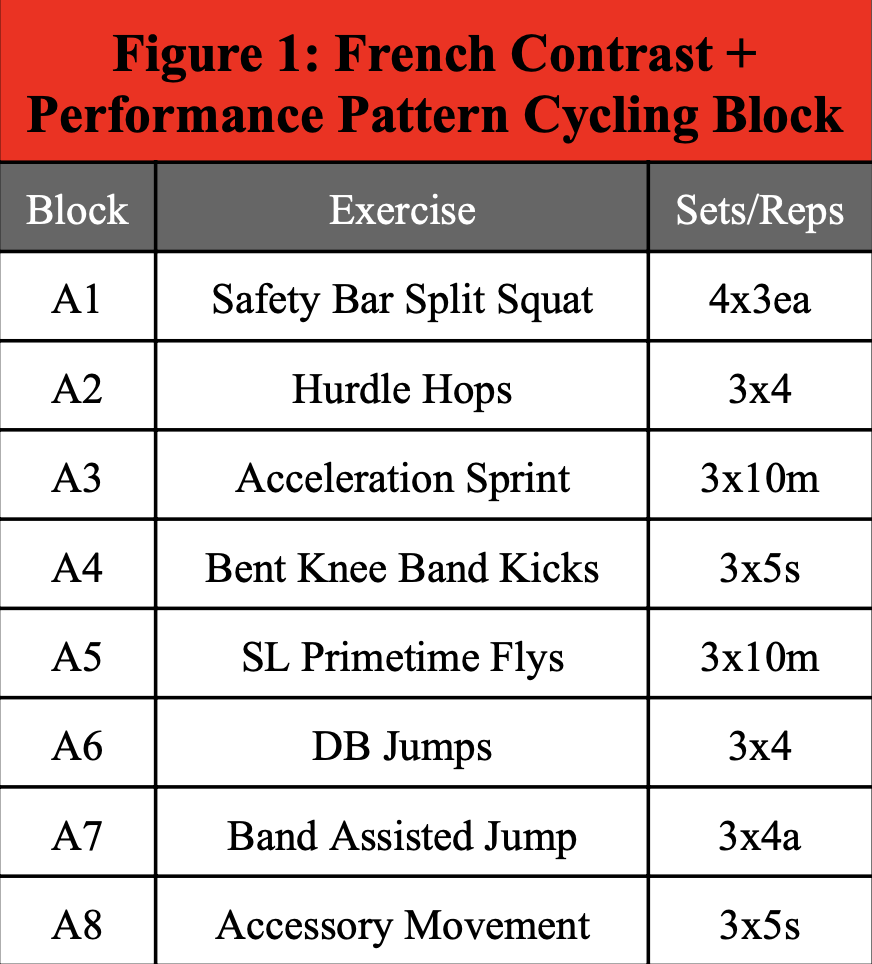
I learned from Cal Dietz in Summer 2021 for this population wouldn’t have worked because of
all the nuances and details that would have to be explained. For an example of the French
Contrast with Performance Cycling refer to Figure 1 for a general overview.
If your athlete has never performed a weighted jump or the fundamentals of olympic lifting
derivatives, then you’ll be at risk for setting them up to fail and waste their time. Keep your
programs simple, prioritize the important movements and always think about your coaching
philosophy/principles. For me, if I have 2-3 days per week to train athletes, my approach will be
total body with a squat, hinge, upper body push, upper body pull, single-leg , core, and explosive
movements. Along with that, if you are programming out 2-3 blocks of strength, then consider
having 1 primary movement paired up with either an explosive or accessory movement. You will
get more efficiency if you think in this framework and the athletes will get the most out of each
movement too. A good example of what I’ve done that worked well with Cheer and Dance was
this down below in Figure 2. Always remember the principles and objectives you are aiming to
achieve with your athletes and have them perform the simple movements savagely well!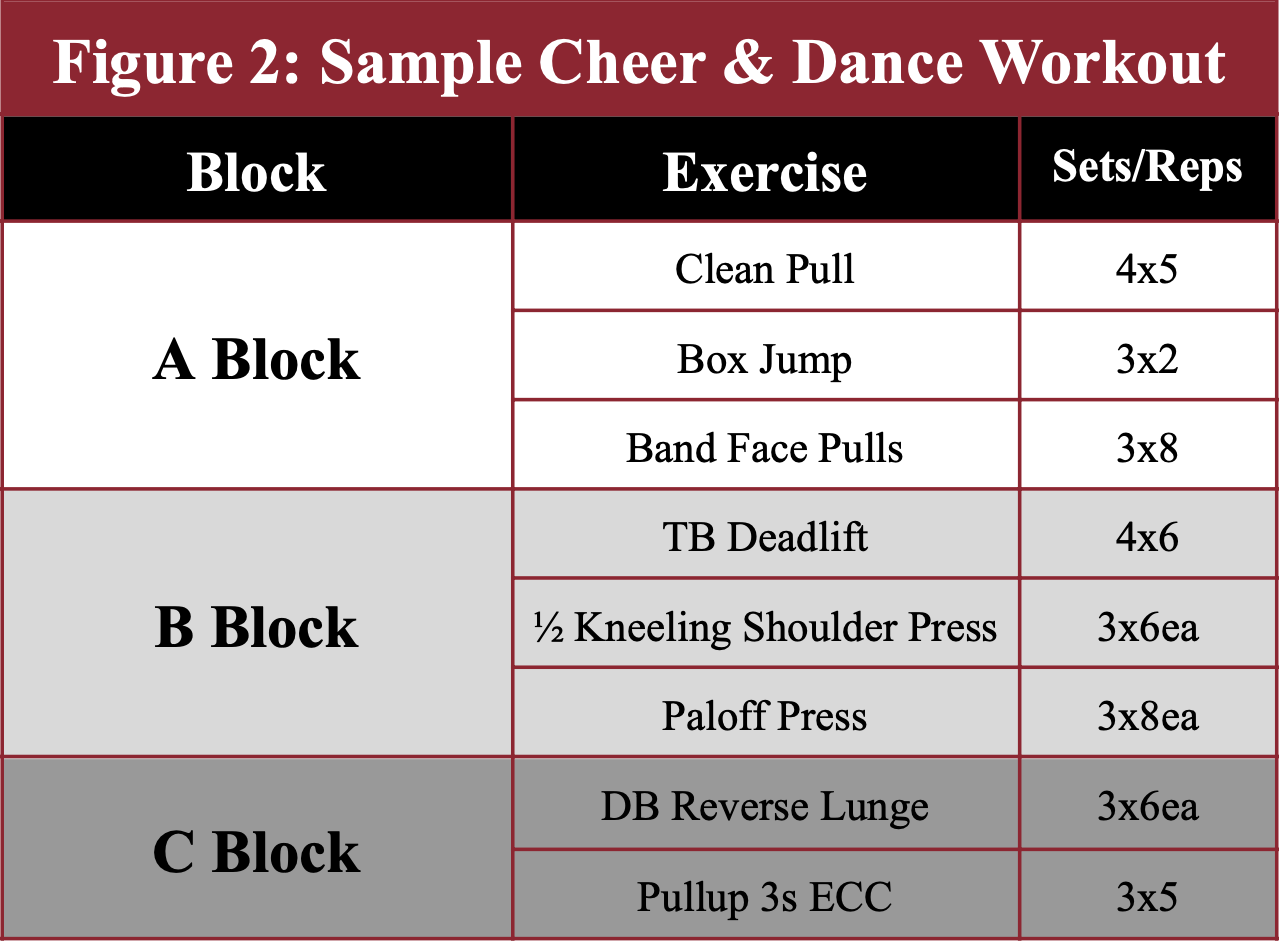
Overcoaching & Talking too much
I would be lying to you all if I said I was the perfect coach and did not have moments
where I was reciting every single step of every exercise. I know I fell into the trap of explaining
about 5 coaching cues or more. You want to greatly reduce that and go with three or less. Start
out with a 10,000 square foot view. Look at the overall picture first and then, zoom into the
final touches once they’ve gotten the big picture down pat.
For example, if you want to break down the execution of the Trapbar Deadlift, focus on
the three most important cues that you can think of. An example could be, set your feet hip width
apart/enter the hexagon, squat down to grab the handle with a straight back and then push
through the floor with your feet to pick up the weight. Once most of the athletes master the big
picture, then you can focus on smaller details such as their head position, hand position or
shoulder retraction while maintaining movement integrity.
Understand soft skills and remember that you are working with human beings!
Yes you are spending many hours in a weight room and on the field, but at the same time,
you will likely have to adjust your program and turn to your soft skills to adjust. This is your
ability to communicate effectively, reading body language, and most importantly, listening to
your athletes. I made it a habit to check in with the team early before they started the session and
would always ask them how their day was and get a read of how they were going into the
session. If they communicated to me that they got a few hours of sleep or they weren’t having the
best day, then I listened to that information and made adjustments for them if it was deemed
necessary.
For example, if the athlete was assigned back squats at 80% relative intensity and they show
signs of sleep deprivation, you could always give them a range to work with. Consider going as
far down as 70% for the day. Or possibly even lower like 60-65% to maintain technical
proficiency without the central nervous system fatigue that could lead to a bad injury. That alone
will gain trust between you and the athlete. If you can’t listen or connect with the athlete, then
you will struggle with coaching them.
Take an interest in their sport, show up to their gameday and understand as much as possible
about their daily routines
One of the ways that I did well with creating connection, trust and buy-in with my cheer
and dance athletes was simply by taking an interest in their sport. I made time to show up to their
practices which occurred late in the evening at 7 pm. Giving your time to people is in my opinion
the greatest gift you can give. Taking the initiative to show up and be there for when they are
doing their sport will go a long way. Additionally, I talked about their upcoming competitions
they had with their routines they were working on.
Athletes do not care about where you have been before and what your resume shows. They want
to know if you will show that your actions reflect that you truly care for them as people outside
of the weight room. If you are willing to simply show up for their competitions, understand what
they do outside of strength and conditioning training and take a genuine interest in their sport,
you will build respect overtime with your athletes…guaranteed! It all starts with taking an
interest in their sport and showing them that you care about them as people.
Be prepared to wear many different hats and learn as many skills as possible
Lastly, be prepared to take on many different tasks as a Graduate Assistant. This will
prepare you well for when you eventually become an Assistant where you do more than just
write a typical program for athletic development. These tasks can include running a nutrition
budget log, picking up nutrition orders at your local Costco, running the social media page or
teaching new interns about the details of the other programs the coaching staff had. Be prepared
to take on more and embrace the challenges of taking on many different tasks. They will only
help you develop into a well-rounded person for the future.
The transition from an intern to a Graduate Assistant is one of the most transformative periods in
a strength coach’s career. It is the time when your theoretical knowledge meets the messy,
unpredictable reality of the weight room or field. Through my time at Temple University, I
learned that while your programming matters, your ability to adapt to constraints, communicate
with empathy, and handle the "unseen" tasks of the job is what truly defines your success.
If you are a new GA, remember to keep your programs simple, your cues even simpler, and your
focus on the athletes as human beings. By showing up for their sport and embracing every "hat"
you’re asked to wear from nutrition runs to social media, you don't just become a better coach;
you become an indispensable part of their athletic journey. The GA years are demanding, but if
you approach them with a willingness to listen and a desire to learn from your mistakes, you will
build a foundation that lasts far beyond your graduation date.
If you need help making the most of your GA experience, reach out to me through my email at
mike@coachmbbrown.com or my Instagram @coachmbbrown. Thanks for reading, everyone!
Mike Brown
Strength Coach Network