Rethinking Landing Metrics: The Value of the First Peak
Understanding stiff vs. modulated landing strategies without overcorrecting.
Reposted with author's permission.
I’ve always been skeptical about overanalyzing landing metrics. The landing phase is usually the forgotten stepchild of the jump. Athletes don’t care about it, coaches often glance at it last, and it ends up treated like leftover data rather than something intentional.
And to be fair, most of the time that skepticism is justified.
That said, there is one element of the landing curve that deserves attention: the first peak.
That initial impact peak can reveal how an athlete instinctively accepts load. In some athletes, particularly those dealing with knee pain, you’ll often see a very sharp, high first peak with almost no hesitation in the curve. In practical terms, this suggests a stiff, abrupt load acceptance strategy. The system produces force quickly, aggressively, and often through fewer structures than we’d like. This curve will also show a fast come back to system weight.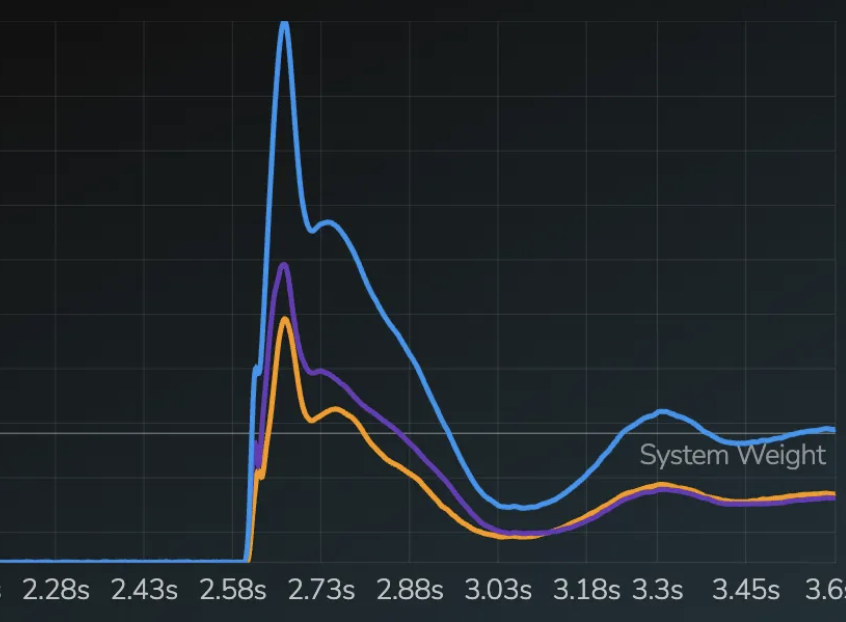
In contrast, a “noisier” landing pattern, where one or more smaller peaks appear before the main peak, tends to be more desirable. These curves suggest the athlete is distributing load across time and across tissues. It’s not chaos. It’s modulation. Multiple structures sharing the work instead of one joint taking the hit.
This isn’t automatically a problem to fix. It doesn’t demand an immediate intervention, nor does it mean the athlete is broken… it doesn’t even mean that this is a problem, but it could become one if that strategy is translated into de court or the field. A consistently high, abrupt first peak may tell us the athlete could benefit from yielding strategies. Drills that emphasize controlled deceleration, progressive force acceptance, and better patterning when landing in deeper-range positions.
Think of it less as a red flag and more as a quiet signal. Not something to panic over, but something to keep in mind when deciding how much attention you give to landing mechanics, braking strategies, and force acceptance work.
The landing may still be the least glamorous part of the jump. But that first peak can tell you more than most people are willing to notice.
About the author:
Rodrigo Alvira Isla is a Sports Performance Coach at Detroit Pistons. Additionally he is a Spanish sports performance coach who moved to the U.S. in 2014 for basketball and academic pursuits. He has worked in Dubai, Lincoln University, and Grand Canyon University, specializing in basketball and volleyball. Founder of Spaniard Performance, Rodrigo bridges scientific research with practical applications and mentors coaches and athletes online. He also consults for Vitruve and other sports science companies.
LinkedIn Page
Instagram Page
Rodrigo Alvira Isla
Strength Coach Network